Orlando is one of Florida’s busiest and most dynamic cities, with bustling highways, busy intersections, and a constant influx of tourists navigating its streets. This combination of heavy local traffic, out-of-town drivers, and major highways like I‑4 and the Florida Turnpike creates a unique traffic environment where accidents are, unfortunately, common.
Recent crash trends highlight that Orlando experiences thousands of car accidents every year, ranging from minor fender‑benders to serious, injury-causing collisions. Understanding these trends is important not only for keeping residents and visitors safe but also for raising awareness of the factors that contribute to crashes in this vibrant city.
Table of Contents
How Many Car Crashes Happen in Orlando Each Year?
The Most Affected Demographics in Orlando Collisions
High-Risk Roads and Intersections in Orlando, Florida
Peak Times for Car Accidents in Orlando
Most At-Risk Demographics in Orlando Fatal Car Accidents
The Most Common Reasons for Orlando Auto Collisions
Statistics on DUI Accidents in Florida
Motorcycle Collision Numbers in Orlando
Frequency of Orlando Bicycle Accidents
How Many Pedestrian Accidents Occur in Orange County?
Hit-and-Run Incidents in Orlando
Frequency of Distracted Driving Crashes in Orlando
Comparing Car Accident Statistics in Orlando to Statewide Data
How Many Car Crashes Happen in Orlando Each Year?
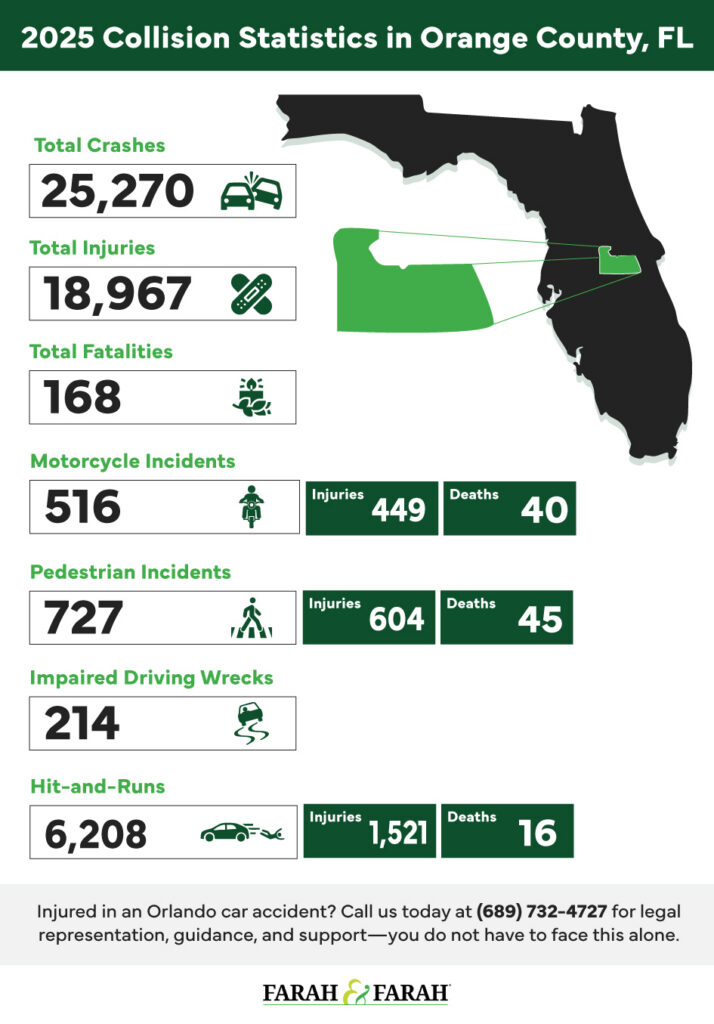
Orlando is the largest city in Orange County, Florida. The county recorded 25,270 accidents in 2025, resulting in 18,967 injuries and 168 fatalities. As of February 2026, there have been 1,925 collisions and over 1,400 injuries.
Since 2022, Orlando has recorded about 58 daily crashes, making it one of the state’s top cities for traffic accidents. Further data show that over the past three years, total annual collisions have increased steadily between 2% and 4%
The Most Affected Demographics in Orlando Collisions
In 2023, Florida recorded 395,175 auto accidents. Among the individuals involved in these incidents, 131,064 were aged 50-64, 77,128 were 65 or older, and 73,091 were aged 20-24.
State data shows that male drivers are twice as likely to be in fatal car crashes as female drivers. One possible contributor to this is that men are much more likely to engage in risky driving behaviors such as speeding, impaired driving, and not using seatbelts.
Vehicle Types Involved in Crashes
Commercial trucks are involved in only around 3 to 4% of total crashes statewide. However, these vehicle collisions account for a disproportionate amount of fatalities and severe injuries. That said, private vehicles, including passenger cars and SUVs, make up more than half of all auto wrecks in the state.
High-Risk Roads and Intersections in Orlando, Florida
Orlando has numerous roads and highways that intersect with those of nearby cities. Overall, state data indicate that motor vehicle accidents are more heavily concentrated in the northern part of the city, particularly west of the Orlando Executive Airport.
Additionally, the National Highway Traffic Safety Administration reports that I-4 is one of the most dangerous roadways in Orlando, with an average of 34 fatal car accidents per 100 miles. This is likely due to congestion from high tourism volumes, construction zones, and commercial traffic. Several other notable roads and corridors in the Orlando area include the following:
- John Young Parkway (SR 423): 973 crashes between 2018 and 2023, with 38 involving death or serious injury
- Sand Lake Road and Turkey Lake Road: Major arterial with frequent collisions
- Orange Blossom Trail (US‑441): Busy urban corridor
- Colonial Drive (SR 50), Semoran Blvd (SR 436), International Drive (I‑Drive): Urban streets with high numbers of crashes
Peak Times for Car Accidents in Orlando
As in other parts of the U.S., auto collisions are more likely in Orlando when certain risk factors are present, including congestion and dangerous driving.
Rush Hour
Crashes are more common during rush hour, specifically between 7 a.m. and 9 a.m. and 4 p.m. and 6 p.m. More drivers are on the roads during these peak hours, commuting to and from work and dropping off or picking up children at school. As a result, congestion increases the risk of rear-end collisions from stop-and-go traffic and sideswipes from sudden lane changes.
Late at Night
Along with the risks of rush-hour traffic, traveling late at night can be more dangerous. Despite less traffic on the roads, the hours between 10 p.m. and 2 a.m. see higher incidences of impaired driving, speeding, and fatigue-related crashes.
According to traffic data, fatal crashes involving drunk driving are much higher at night, with the highest number of impaired fatalities occurring between midnight and 3 am. In Florida, 2 a.m. is the deadliest hour for crashes, with risks five times higher than daytime because of impairment, fatigue, and low visibility.
Summer and Spring
In 2024 alone, Orlando had over 75 million visitors, making it the most-visited city in the U.S. Out-of-town drivers are especially common during the Spring and Summer months. However, the surplus of tourists, who may be unfamiliar with local roads, increases traffic congestion and the risk of driver errors and accidents.
Orlando’s rainy season runs from late May to mid-October, with the peak months being July to early September. Rain during this period often comes in short, intense bursts, quickly creating slick road surfaces and increasing the risk of hydroplaning, which can lead to collisions. In Orlando, rain accounts for about 9% of fatal crashes, making it a leading factor in deadly collisions.
Most At-Risk Demographics in Orlando Fatal Car Accidents
In Orlando, male drivers under 25 face the highest risk of fatal collisions, largely due to greater driving exposure, a higher tendency to speed or drive under the influence, and generally riskier behavior on the road.
However, older drivers, particularly those over 65, may be at greater risk of succumbing to severe injuries in a crash. Similarly, motorcyclists and bicyclists may suffer deadlier injuries, even in a moderate collision, due to less external protection and greater impact.
The Most Common Reasons for Orlando Auto Collisions
Numerous factors contribute to crashes in the Orlando area, with some being more prevalent than others. Below is a summary of the most common causes of accidents in Florida based on 2023 data.
- Distracted Driving: 106,350 people were involved in crashes attributed to behaviors like texting, talking on the phone, or eating while driving.
- Speeding: 1,063 accident fatalities were directly tied to speeding.
- Impaired Driving: Alcohol and drugs play a role in around 30% of traffic deaths.
Along with these, failure to yield, aggression, and weather-related factors are also common contributors to collisions in Florida.
Statistics on DUI Accidents in Florida
Driving under the influence of drugs or alcohol significantly increases the chances of an accident and the severity of resulting injuries. In 2023, Florida recorded over 6,000 impaired‑driving crashes, which accounted for roughly 1.5% of all reported accidents. Of those incidents, 898 were fatal, making up nearly 29% of all traffic fatalities in the state.
Motorcycle Collision Numbers in Orlando
In 2025, 8,874 motorcycle crashes were reported statewide, and 7,650 riders suffered injuries, and 574 died. More specifically, Orange County saw 516 motorcycle collisions, 449 injuries, and 40 fatalities.
Frequency of Orlando Bicycle Accidents
Orlando offers over 265 miles of bicycle lanes, making it highly bikeable. However, the combination of drivers and cyclists sharing the road also increases the risk of deadly collisions.
Orange County had 682 bicycle wrecks in 2025, resulting in 646 injuries. The high volume of injuries that came from these accidents showcases just how dangerous a crash between a passenger vehicle and a bicycle can be.
How Many Pedestrian Accidents Occur in Orange County?
Drivers must be aware and vigilant when navigating residential areas and densely populated cities. School zones, shopping centers, and parking lots are hot spots for pedestrian-related collisions. Orange County alone had 727 pedestrian accidents, and 45 of these incidents resulted in a fatality.
Hit-and-Run Incidents in Orlando
Florida sees thousands of hit‑and‑run crashes each year, causing serious injuries and hundreds of deaths, with Orlando contributing a significant share. Over 105,000 hit‑and‑run crashes were logged statewide in 2023, and incidents led to nearly 22,700 total injuries and 276 deaths.
Frequency of Distracted Driving Crashes in Orlando
Distracted driving is one of the most common causes of collisions, not only in Florida but across the United States. In 2023, an estimated 3,275 people were killed in crashes involving distracted drivers nationwide. Similarly, nearly 300 Floridians died from distracted driving the same year. Over 105,000 hit‑and‑run crashes were logged statewide in 2023, and incidents led to nearly 22,700 total injuries and 276 deaths.
Comparing Car Accident Statistics in Orlando to Statewide Data
Florida sees hundreds of thousands of auto collisions each year. Among its many populous cities, Orlando ranks fourth in the number of car accidents, just under Tampa. Orange County as a whole makes up nearly 7% of the state’s crashes and 8% of injuries from these incidents.
Contact Our Legal Team Today To Get Help With Your Orlando Car Accident Claim
If you’ve been injured in an Orlando car accident, our experienced legal team is here to guide you every step of the way. Reach out now for a free consultation and to learn your options. Call us today at (407) 329-5054 or contact us online to get started.